•  
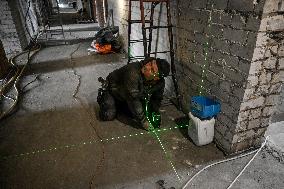
Ukraines 2nd Superhumans Center under construction in Dnipro

Ukraines 2nd Superhumans Center under construction in Dnipro

A builder uses a laser level at the construction site of Ukraines second prosthetics and rehabilitation centre, Dnipro, Ukraine, on April 11, 2025. (Photo by Dmytro Smolienko/Ukrinform)

  •  

Digital technologies help with Yungang Grottoes protection in N China

STORY: Digital technologies help with Yungang Grottoes protection in N China SHOOTING TIME: recent footage DATELINE: June 11, 2024 LENGTH: 00:01:29 LOCATION: TAIYUAN, China CATEGORY: TECHNOLOGY/CULTURE SHOTLIST: 1. SOUNDBITE (Chinese): PAN PENG, Digital protection center of Yungang Research Institute 2. various of technologies applied on Yungang Grottoes protection STORYLINE: Yungang Grottoes in China's Datong is a UNESCO World Heritage site featuring over 50,000 stone Buddhist sculptures It is considered a pinnacle of Chinese Buddhist art and represents the highest level of sculptural artistry in the world during the 5th century Nowadays, digital technologies are helping with its protection SOUNDBITE (Chinese): PAN PENG, Digital protection center of Yungang Research Institute "The challenging part of this work is its meticulous nature, much like knitting a sweater. We primarily use three methods for cave digitization. One method involves a handheld 3D laser scanner, which is mainly used to capture d

  •  
(EyesOnSci) CHINA-SHANGHAI-OPTICAL DISK-RESEARCHERS (CN)

(EyesOnSci) CHINA-SHANGHAI-OPTICAL DISK-RESEARCHERS (CN)

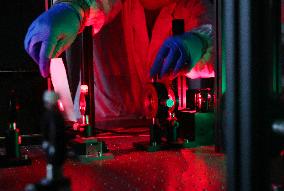
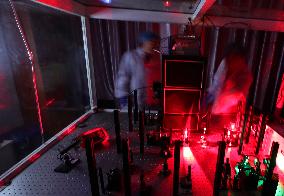
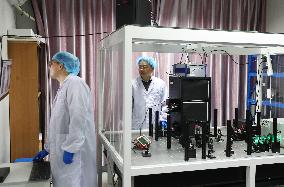
(240303) -- SHANGHAI, March 3, 2024 (Xinhua) -- Researcher Zhao Miao observes experiment materials at a laboratory in the Shanghai Institute of Optics and Fine Mechanics, Chinese Academy of Sciences in east China's Shanghai, Feb. 29, 2024. A three-dimensional nanoscale optical disk memory with petabit capacity has been developed at the Shanghai Institute of Optics and Fine Mechanics, Chinese Academy of Sciences, according to an article published on Feb. 22 in Nature. The research team managed to increase the capacity of optical data storage to the petabit level by extending the planar recording architecture to three dimensions with hundreds of layers, while also breaking the optical diffraction limit barrier of the recorded spots. The minimum spot size and lateral track pitch are 54 nm and 70 nm, respectively. The team developed an optical recording medium based on a photoresist film doped with aggregation-induced emission dye, which can be optically stimulated by femtosecond laser beams. The new tech

  •  
(EyesOnSci) CHINA-SHANGHAI-OPTICAL DISK-RESEARCHERS (CN)

(EyesOnSci) CHINA-SHANGHAI-OPTICAL DISK-RESEARCHERS (CN)

(240303) -- SHANGHAI, March 3, 2024 (Xinhua) -- Researcher Ruan Hao works at a laboratory in the Shanghai Institute of Optics and Fine Mechanics, Chinese Academy of Sciences in east China's Shanghai, Feb. 29, 2024. A three-dimensional nanoscale optical disk memory with petabit capacity has been developed at the Shanghai Institute of Optics and Fine Mechanics, Chinese Academy of Sciences, according to an article published on Feb. 22 in Nature. The research team managed to increase the capacity of optical data storage to the petabit level by extending the planar recording architecture to three dimensions with hundreds of layers, while also breaking the optical diffraction limit barrier of the recorded spots. The minimum spot size and lateral track pitch are 54 nm and 70 nm, respectively. The team developed an optical recording medium based on a photoresist film doped with aggregation-induced emission dye, which can be optically stimulated by femtosecond laser beams. The new technology marks the world's

  •  
(EyesOnSci) CHINA-SHANGHAI-OPTICAL DISK-RESEARCHERS (CN)

(EyesOnSci) CHINA-SHANGHAI-OPTICAL DISK-RESEARCHERS (CN)

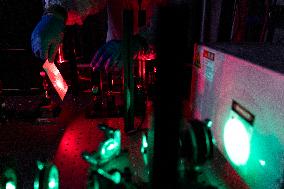
(240303) -- SHANGHAI, March 3, 2024 (Xinhua) -- Researcher Zhao Miao debugs experiment equipment at a laboratory in the Shanghai Institute of Optics and Fine Mechanics, Chinese Academy of Sciences in east China's Shanghai, Feb. 29, 2024. A three-dimensional nanoscale optical disk memory with petabit capacity has been developed at the Shanghai Institute of Optics and Fine Mechanics, Chinese Academy of Sciences, according to an article published on Feb. 22 in Nature. The research team managed to increase the capacity of optical data storage to the petabit level by extending the planar recording architecture to three dimensions with hundreds of layers, while also breaking the optical diffraction limit barrier of the recorded spots. The minimum spot size and lateral track pitch are 54 nm and 70 nm, respectively. The team developed an optical recording medium based on a photoresist film doped with aggregation-induced emission dye, which can be optically stimulated by femtosecond laser beams. The new techno

  •  
(EyesOnSci) CHINA-SHANGHAI-OPTICAL DISK-RESEARCHERS (CN)

(EyesOnSci) CHINA-SHANGHAI-OPTICAL DISK-RESEARCHERS (CN)

(240303) -- SHANGHAI, March 3, 2024 (Xinhua) -- Researcher Zhao Miao debugs experiment equipment at a laboratory in the Shanghai Institute of Optics and Fine Mechanics, Chinese Academy of Sciences in east China's Shanghai, Feb. 29, 2024. A three-dimensional nanoscale optical disk memory with petabit capacity has been developed at the Shanghai Institute of Optics and Fine Mechanics, Chinese Academy of Sciences, according to an article published on Feb. 22 in Nature. The research team managed to increase the capacity of optical data storage to the petabit level by extending the planar recording architecture to three dimensions with hundreds of layers, while also breaking the optical diffraction limit barrier of the recorded spots. The minimum spot size and lateral track pitch are 54 nm and 70 nm, respectively. The team developed an optical recording medium based on a photoresist film doped with aggregation-induced emission dye, which can be optically stimulated by femtosecond laser beams. The new techno

  •  
(EyesOnSci) CHINA-SHANGHAI-OPTICAL DISK-RESEARCHERS (CN)

(EyesOnSci) CHINA-SHANGHAI-OPTICAL DISK-RESEARCHERS (CN)

(240303) -- SHANGHAI, March 3, 2024 (Xinhua) -- Researchers perform an experiment at a laboratory in the Shanghai Institute of Optics and Fine Mechanics, Chinese Academy of Sciences in east China's Shanghai, Feb. 29, 2024. A three-dimensional nanoscale optical disk memory with petabit capacity has been developed at the Shanghai Institute of Optics and Fine Mechanics, Chinese Academy of Sciences, according to an article published on Feb. 22 in Nature. The research team managed to increase the capacity of optical data storage to the petabit level by extending the planar recording architecture to three dimensions with hundreds of layers, while also breaking the optical diffraction limit barrier of the recorded spots. The minimum spot size and lateral track pitch are 54 nm and 70 nm, respectively. The team developed an optical recording medium based on a photoresist film doped with aggregation-induced emission dye, which can be optically stimulated by femtosecond laser beams. The new technology marks the

  •  
(EyesOnSci) CHINA-SHANGHAI-OPTICAL DISK-RESEARCHERS (CN)

(EyesOnSci) CHINA-SHANGHAI-OPTICAL DISK-RESEARCHERS (CN)

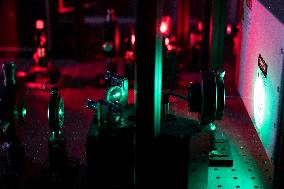
(240303) -- SHANGHAI, March 3, 2024 (Xinhua) -- This photo taken on Feb. 29, 2024 shows experiment materials in the Shanghai Institute of Optics and Fine Mechanics, Chinese Academy of Sciences in east China's Shanghai. A three-dimensional nanoscale optical disk memory with petabit capacity has been developed at the Shanghai Institute of Optics and Fine Mechanics, Chinese Academy of Sciences, according to an article published on Feb. 22 in Nature. The research team managed to increase the capacity of optical data storage to the petabit level by extending the planar recording architecture to three dimensions with hundreds of layers, while also breaking the optical diffraction limit barrier of the recorded spots. The minimum spot size and lateral track pitch are 54 nm and 70 nm, respectively. The team developed an optical recording medium based on a photoresist film doped with aggregation-induced emission dye, which can be optically stimulated by femtosecond laser beams. The new technology marks the worl

  •  
(EyesOnSci) CHINA-SHANGHAI-OPTICAL DISK-RESEARCHERS (CN)

(EyesOnSci) CHINA-SHANGHAI-OPTICAL DISK-RESEARCHERS (CN)

(240303) -- SHANGHAI, March 3, 2024 (Xinhua) -- Reseachers wear masks at a laboratory in the Shanghai Institute of Optics and Fine Mechanics, Chinese Academy of Sciences in east China's Shanghai, Feb. 29, 2024. A three-dimensional nanoscale optical disk memory with petabit capacity has been developed at the Shanghai Institute of Optics and Fine Mechanics, Chinese Academy of Sciences, according to an article published on Feb. 22 in Nature. The research team managed to increase the capacity of optical data storage to the petabit level by extending the planar recording architecture to three dimensions with hundreds of layers, while also breaking the optical diffraction limit barrier of the recorded spots. The minimum spot size and lateral track pitch are 54 nm and 70 nm, respectively. The team developed an optical recording medium based on a photoresist film doped with aggregation-induced emission dye, which can be optically stimulated by femtosecond laser beams. The new technology marks the world's firs

  •  
(EyesOnSci) CHINA-SHANGHAI-OPTICAL DISK-RESEARCHERS (CN)

(EyesOnSci) CHINA-SHANGHAI-OPTICAL DISK-RESEARCHERS (CN)

(240303) -- SHANGHAI, March 3, 2024 (Xinhua) -- Researchers perform an experiment at a laboratory in the Shanghai Institute of Optics and Fine Mechanics, Chinese Academy of Sciences in east China's Shanghai, Feb. 29, 2024. A three-dimensional nanoscale optical disk memory with petabit capacity has been developed at the Shanghai Institute of Optics and Fine Mechanics, Chinese Academy of Sciences, according to an article published on Feb. 22 in Nature. The research team managed to increase the capacity of optical data storage to the petabit level by extending the planar recording architecture to three dimensions with hundreds of layers, while also breaking the optical diffraction limit barrier of the recorded spots. The minimum spot size and lateral track pitch are 54 nm and 70 nm, respectively. The team developed an optical recording medium based on a photoresist film doped with aggregation-induced emission dye, which can be optically stimulated by femtosecond laser beams. The new technology marks the

  •  
(EyesOnSci) CHINA-SHANGHAI-OPTICAL DISK-RESEARCHERS (CN)

(EyesOnSci) CHINA-SHANGHAI-OPTICAL DISK-RESEARCHERS (CN)

(240303) -- SHANGHAI, March 3, 2024 (Xinhua) -- Researchers perform an experiment at a laboratory in the Shanghai Institute of Optics and Fine Mechanics, Chinese Academy of Sciences in east China's Shanghai, Feb. 29, 2024. A three-dimensional nanoscale optical disk memory with petabit capacity has been developed at the Shanghai Institute of Optics and Fine Mechanics, Chinese Academy of Sciences, according to an article published on Feb. 22 in Nature. The research team managed to increase the capacity of optical data storage to the petabit level by extending the planar recording architecture to three dimensions with hundreds of layers, while also breaking the optical diffraction limit barrier of the recorded spots. The minimum spot size and lateral track pitch are 54 nm and 70 nm, respectively. The team developed an optical recording medium based on a photoresist film doped with aggregation-induced emission dye, which can be optically stimulated by femtosecond laser beams. The new technology marks the

  •  
(EyesOnSci) CHINA-SHANGHAI-OPTICAL DISK-RESEARCHERS (CN)

(EyesOnSci) CHINA-SHANGHAI-OPTICAL DISK-RESEARCHERS (CN)

(240303) -- SHANGHAI, March 3, 2024 (Xinhua) -- Researchers perform an experiment at a laboratory in the Shanghai Institute of Optics and Fine Mechanics, Chinese Academy of Sciences in east China's Shanghai, Feb. 29, 2024. A three-dimensional nanoscale optical disk memory with petabit capacity has been developed at the Shanghai Institute of Optics and Fine Mechanics, Chinese Academy of Sciences, according to an article published on Feb. 22 in Nature. The research team managed to increase the capacity of optical data storage to the petabit level by extending the planar recording architecture to three dimensions with hundreds of layers, while also breaking the optical diffraction limit barrier of the recorded spots. The minimum spot size and lateral track pitch are 54 nm and 70 nm, respectively. The team developed an optical recording medium based on a photoresist film doped with aggregation-induced emission dye, which can be optically stimulated by femtosecond laser beams. The new technology marks the

  •  
(EyesOnSci) CHINA-SHANGHAI-OPTICAL DISK-RESEARCHERS (CN)

(EyesOnSci) CHINA-SHANGHAI-OPTICAL DISK-RESEARCHERS (CN)

(240303) -- SHANGHAI, March 3, 2024 (Xinhua) -- Researcher Zhao Miao observes experiment materials via a microscope at a laboratory in the Shanghai Institute of Optics and Fine Mechanics, Chinese Academy of Sciences in east China's Shanghai, Feb. 29, 2024. A three-dimensional nanoscale optical disk memory with petabit capacity has been developed at the Shanghai Institute of Optics and Fine Mechanics, Chinese Academy of Sciences, according to an article published on Feb. 22 in Nature. The research team managed to increase the capacity of optical data storage to the petabit level by extending the planar recording architecture to three dimensions with hundreds of layers, while also breaking the optical diffraction limit barrier of the recorded spots. The minimum spot size and lateral track pitch are 54 nm and 70 nm, respectively. The team developed an optical recording medium based on a photoresist film doped with aggregation-induced emission dye, which can be optically stimulated by femtosecond laser beam

  •  

Chinese researchers performing "physical checkup" on Mount Qomolangma glacier

STORY: Chinese researchers performing "physical checkup" on Mount Qomolangma glacier DATELINE: May 6, 2022 LENGTH: 00:01:04 LOCATION: MOUNT QOMOLANGMA BASE CAMP, China CATEGORY: SCIENCE SHOTLIST: 1. various of Chinese scientific expedition team 2. SOUNDBITE (Chinese): WANG WENQIANG, PhD, Center for the Pan-Third Pole Environment, Lanzhou University STORYLINE: Chinese scientific researchers are performing a "physical checkup" of the East Rongbuk glacier at 6,350 meters above sea level on Mount Qomolangma. The checkup will provide first-hand data for the study of glacier changes on Qomolangma, ranging from visible glacier changes to high precision 3D laser scanning at the millimeter level, as well as more microscopic scientific observations. SOUNDBITE (Chinese): WANG WENQIANG, PhD, Center for the Pan-Third Pole Environment, Lanzhou University "We will collect ice and snow samples of the East Rongbuk glacier, as well as soil samples and runoff samples along the way. We will take these samples back to analy

  • Main
  • Top
  • Editorial
  • Creative
  • About Us
  • About ILG
  • Terms of use
  • Company
  • BEHIND
  • Price List
  • Single Plan
  • Monthly Plan
  • Services
  • Shooting
  • Rights Clearance
  • Support
  • FAQ
  • How To Buy
  • Contact Us
  • Become a Partner

© KYODO NEWS IMAGES INC

All Rights Reserved.

  • Editorial
  • Olympics
  • News
  • Sports
  • Japan
  • Tech
  • Royal
  • Disaster
  • NorthKorea
  • Old Japan
  • SNS
  • Creative
  • Food
  • Japan
  • Landscape
  • Animal
  • Popular
  • #Ukraine
  • #China
  • #coronavirus
  • #N. Korea
  • #Russia
  • #Thailand
  • #Ukraine
  • #China
  • #coronavirus
  • #N. Korea
  • #Russia
  • #Thailand
  • Food
  • Japan
  • Landscape
  • Animal
  • Olympics
  • News
  • Sports
  • Japan
  • Tech
  • Royal
  • Disaster
  • NorthKorea
  • Old Japan
  • SNS